


Following the Threads: The Archdeacon Thomas Vincent Beaded Hood Project
Updated: 9 minutes ago
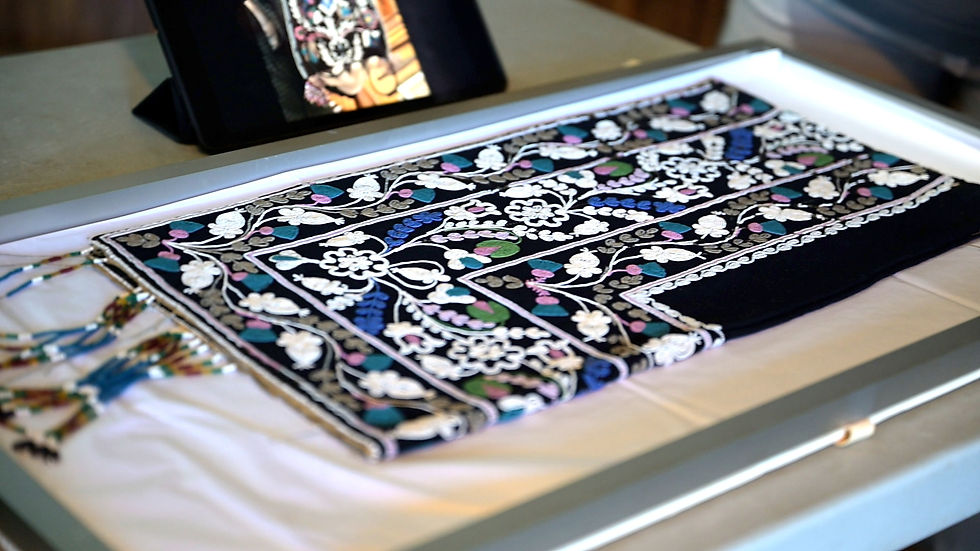
The annual Gathering of our People was once again a tremendous success! Spanning four days, the event featured a wide array of activities, including cultural events, music, and youth programs, offering plenty to experience and enjoy.
One of the most memorable and emotional events that took place at the Hudson's Bay Company Staff House was a deeply special and personal gathering—a moment that would serve to connect generations of a family through a cherished family heirloom, meticulously crafted by their ancestors. This heirloom, a beautifully designed piece of art, not only held immense sentimental value but also embodied the rich history and traditions of the family lineage. The event was marked by a sense of nostalgia as family members came together to celebrate their heritage and the legacy of those who came before them.
Here is a blog by Christina Nielsen, a local community member, who reveals the background of this unique gathering:
"The Archdeacon Thomas Vincent Beaded Hood Project began with Elder Norm Wesley, an old photograph, and a question.
In 2015, Canada’s History magazine published an article about Archdeacon Thomas Vincent of Moose Factory. Among the images was a remarkable photograph of Vincent taken during his 1886 visit to England. In the photograph, Vincent is wearing a beautifully beaded James Bay Cree hood and other pieces of regalia.
Elder Norm Wesley saw the photograph and recognized that it mattered.
Norm began asking questions about the image and the clothing Vincent was wearing. Those questions eventually connected the photograph with Tom Prewer and the beaded hood that had been carefully preserved within the Vincent family for generations. Tom is a descendant of Archdeacon Thomas Vincent and Eliza Ann Gladman Vincent through their daughter Minnie Mary Vincent Prewer. Remarkably, the hood preserved by the family is the same hood Vincent had worn in the 1886 photograph. That connection became the starting point for the research Christina Nielsen and Tom Prewer are carrying forward today.
What initially seemed to be a story about identifying one family belonging soon opened into something much larger: a network of women, families, photographs, beadwork, museum collections, research papers, and archival records stretching across James Bay and far beyond it.
The research builds upon the work of the late Dr. Cath Oberholtzer, whose study of James Bay Cree beaded hoods explored the possibility that women within the interconnected Vincent, Renton, Gladman, and Stuart families played an important role in the development and production of this distinctive style of floral beadwork during the nineteenth century.
This possibility makes the Vincent hood particularly significant. Archdeacon Vincent married Eliza Ann Gladman, placing the hood within one of the very families Oberholtzer identified in her research. Eliza Ann and her sisters Clara Caroline Gladman Vincent and Margaret Hlafman Stuart were granddaughters of Mary Moore Gladman, one of the women associated with this artistic tradition.
The project is now seeking evidence that may allow the artistic contributions of these women, and potentially other James Bay Cree women, to be more clearly understood and acknowledged.
The Vincent hood also possesses an unusually strong family history. It remained within the family, can be connected directly to Archdeacon Vincent through the 1886 photograph, and can now be considered alongside related belongings held in museum collections across Canada and the United States.
Another important clue is a photograph taken at Albany in the 1880s by Dr. Walton Hayden. It shows a Cree woman wearing a strikingly similar beaded hood. The hood she was photographed wearing survives today in the collection of the Smithsonian’s National Museum of the American Indian. Who the woman was, who made her hood, and how the hood eventually entered the museum collection remain important questions.
Together, these photographs and surviving belongings allow us to ask questions that would be much more difficult if the objects or images had disappeared.
Bringing the Hood to GOOP

During the 2026 Gathering of Our People, the research returned to Moose Factory.
Moose River Heritage Hospitality Association hosted two presentations by Christina and Tom in the historic Hudson’s Bay Company Staff House.
The setting carried particular meaning because the Staff House was part of the working and social world of the Gladman and Vincent families. Members of these families worked, lived, gathered, and maintained relationships within this HBC community, and many are buried in the cemetery directly across the street.
Presenting the research in that place connected the archival record, the surviving hood, and the families whose histories are woven through Moose Factory and Albany.
It was a particular honour to have descendants of Archdeacon Thomas Vincent’s brother, James Vincent, and his wife, Clara Caroline Gladman Vincent, in attendance, including Muriel Chum and Susan Vincent. Their daughters, granddaughters, and great-granddaughters were also present, alongside descendants of Thomas Vincent and Eliza Ann Gladman Vincent through Tom Prewer’s family.
Several generations of these connected families were therefore gathered together in a place their ancestors would have known, with the Vincent hood present in the room.
That experience changed the research.
Until then, many of these relationships had been followed through genealogies, correspondence, photographs, museum catalogues, and archival records. At GOOP, those relationships became tangible.

It was an honour to present the research to descendants whose own family histories are part of the story, and to listen as people connected photographs, names, places, memories, and relationships across generations.
The hood felt less like an artifact being displayed and more like a family belonging continuing to connect people, places, and generations. The gathering also reflected something historian Krista Barclay has documented in her research: the important role women often played as creators and stewards of family belongings and in carrying those belongings, stories, and relationships across generations.
Several younger descendants have since expressed interest in the research and in following some of its next threads.
That may ultimately become one of the project’s most meaningful outcomes: research that began with Elder Norm Wesley recognizing the importance of an old photograph now creating opportunities for daughters, granddaughters, and great-granddaughters to participate in carrying the story forward.
Where the Research Goes Next
The next stage is focused on provenance: following the people, belongings, photographs, and records wherever the evidence leads.
The project is continuing to work with museums and archives to trace other James Bay Cree beaded hoods and related belongings and to understand how they entered institutional collections.
Current research includes the Smithsonian Institution, the Metropolitan Museum of Art, the Canadian Museum of History, the Hudson’s Bay Company Archives, the Royal Ontario Museum, Anglican and Church Missionary Society records, the University of Manitoba Archives, and the Oberholtzer archival collection at Aanischaaukamikw Cree Cultural Institute.
One major avenue of research is the Hudson’s Bay Company account records. References to purchases of beads, thread, ribbon, and other materials associated with members of the Vincent and Gladman families may help us understand who was obtaining the materials used in this beadwork tradition and whether those purchases differed from those of other families at the same posts.
Archival correspondence, journals, photographs, wills, family papers, and museum acquisition records may also provide clues about who produced, owned, wore, gifted, and preserved these belongings.
Another important next step is reviewing Dr. Oberholtzer’s research records. Her work identified numerous related James Bay Cree beaded hoods held in collections. Bringing that research together with what is now known about the Vincent hood may help develop a clearer picture of the relationships among the objects, their makers, their families, and the communities from which they came.
The Albany photograph is another important focus. Research is continuing into Dr. Walton Hayden’s papers and photographic records in the hope that additional information may identify the woman in the photograph or clarify how the hood she was wearing later entered the Smithsonian collection.
Another important line of inquiry is a nineteenth-century James Bay Cree beaded hood now held by the Metropolitan Museum of Art in New York and associated with the Strathcona collection. Lord Strathcona, Donald Smith, had deep connections to the Hudson’s Bay Company, while his wife, Isabella Sophia Hardisty, was born at Moose Factory and belonged to the interconnected world of HBC families in which the Gladman and Vincent women lived. She was a contemporary of Eliza Ann, Clara Caroline, and Margaret Gladman.
We are now seeking to establish more precisely how the Strathconas acquired the hood, from whom it came, and when it entered their family collection. If its provenance can be traced back to Moose Factory or to one of these connected family networks, it may provide another important piece of evidence for understanding how James Bay Cree women’s beadwork moved through relationships of family, friendship, gifting, trade, and the wider HBC social world before eventually entering museum collections.
The project is also following the Vincent and Gladman families beyond James Bay, including their connections to Port Hope and other places where family papers, photographs, wills, correspondence, and belongings may have survived.
There are still many unanswered questions. Who made Archdeacon Vincent’s hood? Why did he choose to wear it when he was photographed in England in 1886? Who is the woman photographed wearing a similar hood at Albany? How was artistic knowledge shared among women and families across Rupert’s Land? What can family and community knowledge reveal that institutional records may never have documented? The project continues by listening to family and community knowledge, consulting archival evidence, and following the belongings themselves.
Ultimately, the goal reaches beyond identifying the maker of a single hood. It is about honouring the women whose artistry survives in family and museum collections, reconnecting belongings with the people and places from which they came, and seeking opportunities for artists whose identities have been lost in institutional records to once again be known by name.
There is something fitting about the path the project has taken. It began when Elder Norm Wesley looked carefully at a photograph and recognized that there was more to its story. That same photograph is still asking questions, only now many more people are helping to answer them.


